Showing posts with label museum. Show all posts

Saturday, 23 March 2013

Cesare Borgia's Sword Scabbard - And A Trip To The British Museum

It's long been a dream of mine to look upon Cesare Borgia's sword and the scabbard that went with it. And when I found out that the scabbard was on display at the Victoria & Albert museum in London, I knew I had to go. Yesterday morning, after three and a half hours sleep, I got up and dragged myself and my partner off to London. Let me tell you now, wandering around London on just three and a half hours of sleep isn't a good idea, I was completely exhausted and could barely keep my eyes open. But then, when we got to the Victoria & Albert and saw the scabbard; everything was worth it.


When I saw it, I will admit that I squeaked rather loudly. I'd say it was embarrassing but really, I honestly didn't care. And it seemed to amuse the gallery attendant as I knelt in front of the case examining this beautiful artifact and wiped away my tears. Now I know you'll all think me incredibly sad but sitting in front of this beautiful piece of leather work made me really emotional - the thought that this had been made for Cesare Borgia, and that he had likely held it in his hands was just completely overwhelming. Some will wonder why I get so emotional over a man who had been so ruthless, but having studied him and his family for so long I have the utmost respect for the man who was so ruthless that he took over the whole of the Romagna with ease, yet loved his family more than life itself (But not in THAT way!). And seeing it there, something that was his, something that belonged to a man who I have found interesting for so long and read so much about, it was just simply amazing.

The scabbard itself is beautifully decorated:


On the front there are a number of images. At the top you can see a triumphal arch, under which a group of worshippers sacrifice a ram to either Venus or the Goddess of Peace. At the top of the Triumphal Arch there is an inscription in Latin: "Materium Superabit Opus" which means "Toil will tame the material" - a motto which really fits Cesare, the man who overtook the Romagna with ease, and tamed the people of each city he took over by being both ruthless and fair (Read The Prince by Machiavelli to understand exactly how this worked with Cesare). Beneath this you can see an Imperial Eagle, flanked with scrolls. This points back to Cesare's respect and love for his namesake Caesar (Julius Caesar). The Imperial decoration continues and you can see where it was marked out however this was unfinished. On the reverse, not easily seen in the museum, there are the monograms of Caesar as well as groups of three flames which was the personal impressa of Cesare. There is also a damaged coat of arms (very likely the Borgia coat of arms) flanked by cupids and the Goddess of Peace. 


Image from the Victoria & Albert Museum

The symbolism on the scabbard blew me away. Each image would have been placed there to reflect the mindset of its owner, that mindset being of the ruthless Cesare Borgia. I was completely stunned by the amount of Imperial imagery on the sword, reflecting the personal motto of Cesare; "Aut Caesar, Aut Nihil" - he had the utmost respect for Julius Caesar, and it seems almost hero worshipped him; from all my readings on Cesare it really seems as though he aspired to the same level of brilliance as Caesar.

I wish I could have spent more time with the scabbard, examining it in detail. Unfortunately, due to how fragile the piece is it would have been impossible to handle it (and I did ask when I emailed the museum a few months back). You can really see how fragile it is when you look at it, the back is split, as is the top, and this is likely why it was unfinished. During my research I found something interesting - after it was brought by the museum in 1869 it was described in a report to the Science and Art board as the "finest piece of art in leather ever known" and I can really see now how true that is. I don't think I've seen such a beautiful piece of leather work! Alas, due to what is likely a defect in the leather (the splits in the back) it never would have been worn by Cesare - had it been, it would have been a ceremonial scabbard. As he was a nobleman, Cesare would have worn a sword at most times (his sword, inscribed with his motto is currently in Rome), and such lavishly decorated scabbards would have been a usual sight in the noble courts of Rome. What's funny about this though is that the scabbard suits the shorter blade of the Cinquedea sword, which was a sword much more suited to combat - and indeed his sword is a short bladed Cinquedea. Is this Cesare once more showing the people that he's not a man to be messed with in any situation? It's certainly interesting to think about, I only wish that I could have found a little more information on this piece in the museum book shop. Alas, I could find nothing - I'll have to keep trawling online!


Looking a little emotional there...

After tearing myself away, ever so emotional, we decided to head to the British Museum for the afternoon. After a rather nice lunch in the little pub just opposite the museum we headed over there, and as we were walking in we spotted musician Gareth Malone! I think I might have scared him a little when I squeaked "It's that bloke from the telly!" - we didn't stop him, instead I stuck my head down and shuffled past embarrassed. Oops. 

Below are a few photos of my favourite pieces from the British Museum:


The Rosetta Stone - I spent a while stood here, explaining to my partner just how important this artifact is.


This beautiful statue of Venus once belonged to Sir Peter Lely (court painter of Charles II)


This isn't a very good picture, but this is basically a carved piece of Ivory dating to the thirteenth century. It shows images of the Passion, and Christ's crucifixion.


These are little reliquary boxes dating to the C13/14 - build to hold tiny relics such as sherd's of the True Cross, or a Holy Thorn.


The famous image of Christ from Hinton St Mary. Behind him you can see the Chi-Ro symbol, an early symbol of Christianity.


Ginger, the predynastic mummy. I love this guy, having spent a lot of time researching him at University. He's basically a natural mummy, the heat of the sand from his grave naturally dessicating his skin and giving him remarkable preservation.


Pieces from the Sutton Hoo ship burial.


Turquoise snake from the Aztec exhibition.

All in all, a fantastic day. And I might have spent a fortune in the B.M book shop. Oops!

Cesare's scabbard is currently on display in Room 62 of the Victoria & Albert Museum, South Kensington, London.

Tuesday, 4 September 2012

Tudor House, Southampton


It's been a couple of years since I was last at Tudor House. Last time I was there the place was a building site, part way through a restoration programme. I was an archaeologist then, and I was working with a team of diggers in the gardens. We were basically there to shovel dirt out of the way of the builders. Yet we still found some pretty awesome bits of archaeology including some nice bits of pottery, and one of my colleagues found a rather beautiful stylus. One of my fondest memories is of trying to demolish a little stone wall with a mattock, in the rain. The mattock wasn't working and every time I hit the wall sparks would fly. In the end I had to use a sledgehammer. It was tough work. But damn it felt good when that wall came down!

Today, I decided it was high time I went back. Mainly because I've had nearly three weeks off work due to illness, but also because it's right on my doorstep. So this afternoon I took myself down there. I stood outside for a moment, in the little square facing this absolutely stunning building and I took it all in. The outside hasn't changed a bit since I was last there but it never fails to take my breath away. And then, I took myself inside, paid my entry fee and entered the banqueting hall.

The first thing we were treated to was an audio visual tour giving a brief history of Tudor House as well as a short introduction of how Tudor House became a museum. It was held in a very darkened banqueting hall, with a light show in which it seemed as though the candles were flickering, and noises came from the door behind me. I closed my eyes and I have to say, as the audio of creaking footsteps and barking dogs was being played it was somewhat freaky. It was a brilliant introduction to the history of the house, which I shall go into briefly below before I bombard you with all the photographs that I took.

The house itself dates from the fourteenth century, when in around 1348 a man named John Whytegod owned the land. The lane that runs alongside Tudor House, now known as Blue Anchor Lane, was originally known as Whytegod's lane (I wonder why). Whytegod also owned part of the property nearby known as King John's Palace, part of which can be seen as you wander around Tudor House. In the fifteenth century, Tudor House passed to Walter and Jane William. Walter William inherited the building from his father, and he was a trader who dealt in the shipment of wool and cloth. William was also involved a plot against King Richard III when, in 1483 he was made Mayor of Southampton. Due to his part in the plot, he was branded a traitor and fled to Beaulieu Abbey where he sought sanctuary and died not long afterwards. When Henry VII became king in 1485 after the Battle of Bosworth, he pardoned Williams fellow traitors and his wife became the wealthy owner of Tudor House. She later married Sir John Dawtrey. Following the wedding, the house came into the hands of the Dawtrey family. Sir John, already overseer of the Port of Southampton also owned many property in St Michael's Square near Tudor House, and he decided that a man of his status needed a house to befit him. So he commenced work and joined his houses into a bigger house which became very much like the building today. After Sir John died in 1518, the house passed into the hands of Lady Isobel Lyster (Sir John's widow, who he had married after Jane had died). Lord and Lady Lyster were exceptionally wealthy and conducted huge entertainments at Tudor House. After Isobel's death, Lord Lyster married again and retired permanently to Southampton in 1528. He was the owner of Tudor House until his own death 1554, and there is a monument to him in the church opposite the House. In the 1600's the house belonged to wealthy ship owners (evidence of which can be seen in the graffiti dotting the walls of the house), yet in the Georgian era began to decline, when it was made into a series of dwellings and the nearby area was one of the poorest areas of the city. Not long after, in the early 1800's, the house was made into a museum, yet many changes were made. Doors were added where there had been no doors, a minstrels gallery was added where there was none previously and wood panelling was added to many of the walls in a romanticised version of Tudor building work. However, it is thanks to this work that we still have Tudor House today, and thanks to the work of local historians and archaeologist we now have a history of this fantastic building.

I have to say, even though I spent less than an hour wandering around this beautiful building, I certainly saw more of it than I ever did while I was working here. When I was working in the gardens there was little time to explore the building - even though I did get to see the cellars on my first day. It was an absolute pleasure to wander around and have a look at the displays, and to see the graffiti scrawled on the walls from the 1600's and beyond. And despite the changes made to the place in the Georgian period, you really can get a sense of what it was like there. Plus, it was really very quiet and exceptionally peaceful, which always helps.

Below are some photographs that I took while I was wandering around.

The door on the left originally lead to the Tudor pantry and buttery. The gallery above was added in the Georgian era, as were the oak beams you can see in the wall on the left.


This is apparently a model of Elizabeth I


The beautiful gardens


This corner in the gardens is where I spent most of my time digging. To get rid of spoil we had to hoist buckets over the wall.


Tudor kitchen...apparently


Tudor pottery - we found many examples of this whilst digging


The engraving above could be a "witch mark" - used in medieval and Tudor times to protect against witchcraft (although these are normally two intersecting letter V's), or an insignia or a merchant who lived here at the time.


Beautiful painted beam


Not a very clear picture, but this wall has graffiti on it dating from the 1600's


Poor little stuffed spaniel puppy :(


Greek Amphorae


YAY ARCHAEOLOGY


YAY MORE ARCHAEOLOGY


Ship marks. If you look closely you can see what looks like a boat, and to the right of it and inscription of SCH


And last but not least, the staircase heading towards the exit, decorated with portraits of the family who once lived in Tudor House.

All in all, a fantastic afternoon and well worth the money. If any of you are in Southampton, I urge you all to visit this fantastic little place.

Tuesday, 7 August 2012

Convento Dei Cappuchini, Rome

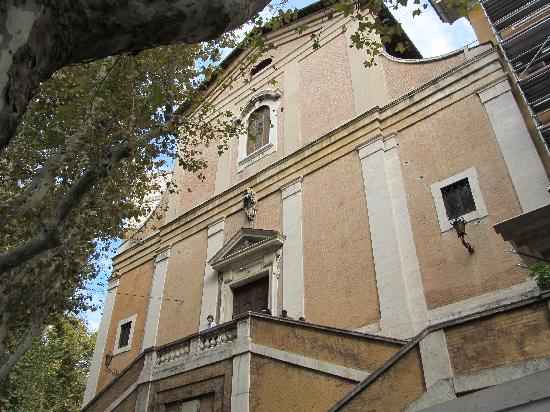
On our final full day in Rome, after we had visited the Colosseum and almost passed out from heat exhaustion, we decided to visit a little church near the Barberini metro station. This little church is often known simply as the "Convento Dei Cappuchini" or Cappuchin Crypt. I had read about this little place online before we left the UK and I just had to visit it before we left Rome.


The crypt itself (which I will get to in more detail in a moment) is located beneath the church of Santa Maria della Concezione dei Cappuccini, or in English Our Lady of the Conception of the Capuchin. The little church itself was commissioned in 1626 by Pope Urban VII. Previously the Capuchin Friars had been housed elsewhere, but when they moved to this church and friary they packed up everything, including the bones of their dead and brought them here. Originally, the bones of the Friars had been buried in the Friary Via dei Lucchesi but the Pope's brother Antoni Barberini ordered everything to be moved, and in the end over 300 cart loads of bones were moved. Today, these bones can be seen arranged in the crypts beneath the friary in quite possibly some of the most morbidly fascinating crypt decorations I have ever seen.

But before you even get to see the crypts, you pay for your entrance in quite a snazzy little entrance hall in the refurbished friary. Having spoken with MadameGuillotine, not so long back you used to be greeted at the doors by one of the monks but alas, not any more (at least when we were there). You are greeted by super friendly staff members in t-shirts with the Friary's logo on. The most surprising thing when we walked in there however was how quiet the place was. Of course I didn't expect it to be anywhere near as busy as the Vatican or Colosseum. But in front of us in the queue was a small family and as we were wandering around the museum we saw no one else. In fact, the family in front of us seemed to waltz through the museum and crypts not even really giving a hoot about any of it. Whereas the two of us spent hours in there, and I have to say it was an incredibly moving experience for me.

I will mention now that whilst we were there I didn't take any photographs due to the battery on my camera running out. Where I can, I have credited any images used below.

First of all however, we get to look around the small museum which is apparently rather new. And I loved it, every single second I spent in this tiny museum totally unhindered by tourists. I have to say it was a really nice, and very peaceful change from the previous places we had been. The museum is utterly chock full of artifacts relating to the life of the Capuchin Friars. The first room we entered was full of portraits including this one by Caravaggio.

 I found this portrait mesmerising, and stood in front of it for a very long time just taking in its details. It seems that the Cappuchin's follow the example of St Francis of Assisi, but the Cappuchin's are much, much stricter than the original order. After the foundation of the order in around 1520, due to their beliefs, they were forced into hiding. But Urban VII ended up saying all was OK with it in around 1528.

The area used for the museum and crypt is used these days completely for those purposes, and just opposite the road the Friar's still live in quiet contemplation.

Beneath the museum, again of which I have no pictures other than what I have scanned in, lies the ossuary and crypt. Even though there are just 6 rooms in the crypt, we spent so much time down here gazing at the macabre decorations in front of us. I say macabre, yet at the same time it was utterly fascinating to think that the bones on show were once friars who had served at the friary. Below are some photographs (not by me) of each room, each of course with full credits to where I got them from).


The Crypt of the Resurrection.
This one is closest to the gift shop and I have to say probably one of the most moving due to the beautiful portrait. The portrait itself is framed by different bones from the human body. This crypt is said to be the least macabre of all six rooms although I have to say that even in here I had a little shudder, yet odd fascination with what I was seeing.

N.b - I'd just like the add here that all throughout my University years I had an odd fascination with human bones, hence why I'm probably flailing a lot about this...

The Mass Chapel
 This is the only room in the crypt with no bones in it. I have to say when I walked into this very peaceful room I was very surprised to not see any decoration. However it seems this room was used to pray for the souls of the dead in the surrounding crypts. There is a plaque within this room that contains the heart of the niece of Sixtus V, and it also contains the tomb of  "The Papal Zouaves" - an infantry force formed in defence of the papal states.Unfortunately I couldn't find any pictures of this room, so I'll have to ask you all to trust me when I say that this was the most peaceful room in the entire place.

The Crypt of Skulls

Looking at the picture, I wonder why it's called the Crypt of Skulls?? I have to say it was incredibly disconcerting walking into these crypts and seeing entire skeletons dressed in Capuchin Robes. I don't know if I'm the only one who felt this way?

Crypt of the Pelvys


I think the name says it all really. This one is made up mainly of pelvis bones!

Crypt of Thigh bones and Leg bones


Apparently the greatest number of bones are buried here in the whole crypt.

Crypt of the Three Skeletons


This room was probably my favourite in the entire crypt. Mainly because of the skeleton mounted on the ceiling which holds a scythe. The skellie on the ceiling is mounted within an oval and holding a scythe, a symbol of both life coming to birth (the skellie within the oval) and a symbol of death (the skellie holding the scythe). The skeleton in the centre of the ceiling is said to be the "Princess Barberini" although I have been unable to find much information on her, even from the guidebook I brought from the museum. The lady in the gift shop began to speak about her but didn't really go into much detail other than, "you need to know the story". Sadly I haven't been able to find much of her story so if anyone knows anything at all then please do drop me an email.

As I said right at the start of this post, the entire place moved me so, so much. Once we were done with the museum and crypt sadly we didn't go and see the church due to being stupidly tired and needing to recharge before finding somewhere to eat that evening. But I have to say, visiting this place was amazing and I am so, so glad that we didn't go home without visiting. Not only was the museum fantastic, but the crypts as well and full of so, so much history (including the history of later Friars who were on TV, as well as a rather moving story of a Friar who was murdered by his driver and assistant (If I could have taken pictures, again I would probably have more information but again, if anyone knows any more then please do email me).

And that was the final stop in our Rome visit. I have to say, we are looking at going again, albeit when the weather is a little bit cooler. Hopefully then we can stay a few days longer and also visit the places that we didn't get to see.

All in all though, an absolutely amazing trip that blew my mind from the moment we stepped foot in the Vatican Museum. Despite its expense (i.e. food), I would recommend visiting Rome to anyone interested in history. Because it is absolutely mind blowing.

Further Reading

The Capuchin Museum (multiple authors), 2012, The Capuchin Museum, Gangemi: Roma (only available at the Museum gift shop)


Further Information

The crypts and museum are generally open from 9am until 6.30pm (last admission), but please check the website or get in contact with the convento itself fore more information on opening.