Showing posts with label sixteenth century. Show all posts

Tuesday, 12 March 2013

The Death of Cesare Borgia

Cesare Borgia

506 years ago today, one of the greatest military commanders that Italy had ever seen was killed at the Siege of Viana. On 12th March 1507, Cesare Borgia rode to his death following a life of extraordinary feats - son (possibly, please see this post for more information on that) of a Pope, the first man ever to resign from the College of Cardinals, Gonfalonier and commander of the Papal armies; he died as he had spent most of the final years of his life, alone. As I'm sure many of my readers are aware, I have the greatest respect for Cesare Borgia and am a huge advocate of dismissing the terrible rumours that surround his life - and so today I will write about his death, the circumstances surrounding it and how its wider effects.

Sergio Peris-Mancheta as Cesare in Los Borgia

Having escaped from his imprisonment in Spain, Cesare headed to Navarre where he joined forces with his father in law Jean D'Albret. There, he spent his time fighting with Jean and helping the King of Navarre besiege various towns. There is a fantastic story in which an old man remembered Cesare passing through the town of Mendigorria at the head of a massive army. The old man spoke of how Cesare was, "a big man, strong, handsome, and soro" (Soro is an untranslatable word used to describe young falcons). It is said that Cesare carried a particular weapon which is incredibly unusual, but mentioned many times by other chroniclers who described Cesare's time in Navarre - a short, thick, double pointed lance. Cesare Borgia, a man who had been imprisoned and suffered great hardship since 1503, was back in the saddle and at the height of health and fitness.

During the first week of March, Cesare joined up with King Jean of Navarre at the town of Viana. The plan was to besiege and take the town from Luis de Beaumonte, a man who held the town on behalf of the Spanish monarchs. Considering as how this town was in the kingdom of Navarre, King Jean wanted the town back in his control and Cesare, the man who had made the Romagna fall to his knees, would have found the town and its castle an easy target. It seems however that Cesare was overconfident and the wariness he was so famous for when it came to warfare had relaxed. In a way, the events of the next few days were somewhat inevitable, given the overconfidence of Borgia, and the lack of experience he had in commanding a fully trained army rather than paid mercenaries.

Mark Ryder as Cesare in Borgia: Faith & Fear

On the night of 11th March, Cesare withdrew his troops into the safety of the town due to a harsh rainstorm. He didn't think that Beaumonte would attack during such bad weather, but this was a mistake and Beaumonte had been waiting for Cesare to make such a move. Under the cover of darkness, Beaumonte lead mules into the town - they were loaded with flour and bread and escorted by 200 lances. They entered the castle unnoticed. At dawn the next day, they noticed a body of cavalry approaching and thought they were reinforcements and so raised their cry. As the words "Beaumonte, Beaumonte!" were cried, the alarm was raised in the town.

Despite the confusion, Cesare leapt onto his horse dressed in light armour and rode out of the town with seventy horseman and his squire, Grasica. He left a note for King Jean to follow. Accounts of what happened during the next few hours conflict quite a lot, but it seems as Cesare galloped out of the Solana gate his horse slipped in the mud and almost fell. Cesare gained control of the horse and rode out of the town shouting:

"Where is he, this little Count?"

Cesare out rode his men, and caught sight of the Beaumonte soldiers as they were retreating to where Beaumonte waited for them. And Cesare Borgia, who had out ridden his men, did not realise he was alone. And as Beaumonte observed the lone horseman galloping forward with his unusual double pointed lance, he sent forward three of his best knights. These men included Garcia de Agreda and Pedro de Allo as well as some foot soldiers. These men waited in ambush, and as Cesare approached they fell upon him. As Cesare raised his arm to strike, Ximenes Garcia stabbed him with a lance under the arm, at the point unprotected by his armour.

Cesare fell from his horse, mortally wounded, yet he still had hold of his lance. He fought desperately, something that is shown fantastically in the Spanish movie "Los Borgia", but it wasn't long until he fell, completely overwhelmed by his attackers.

Cesare's death: Los Borgia

Cesare's death: Los Borgia

Cesare's death: Los Borgia

As he lay there, dead of his wounds, Cesare Borgia was stripped of his armour and left there naked and bleeding. One of the men, it is unknown which, had the decency to cover his genitals with a rock. Later, when his body was examined, at least twenty five stab wounds were found. It was just three days short of the Ides of March when he died, the day that had proven to be fateful to his hero Caesar. It seems that the men who attacked him were completely unaware that it was Cesare Borgia whom they had killed. Cesare's squire, Juanito grasica was found desperately searching for his master and when he was shown the armour that was taken, he burst into tears. It was at that moment that the attackers realised who they had killed. Beaumonte erupted in a rage. He had lost a valuable prize, for the price that was on the head of Duke Valentino alive was a high one. But nothing could be done, and so Beaumonte lead the squire to where Cesare's corpse lay. King Jean of Navarre had Cesare's body carried to Viana.

Cesare Borgia, Duke of Valentinois and the Romagna; ex cardinal and son of Pope Alexander VI was buried in the parish church of Santa Maria in Viana. He was just thirty one when he was killed, and by the time of his death had achieved more than most men of his age ever had. He was buried in an elaborate marble tomb with the inscription:

"Here, in a scant piece of earth, lies he whom all the world feared"

It has since been suggested that Cesare deliberately rode out to his death in a sort of suicidal charge. Historians have previously argued that it was the syphilis that made him do this, that it had affected his brain so much that it made him go mad. However, Bradford has argued that by the time of his death it is more than likely that he was cured of the disease thanks to the malarial fever that he suffered in 1503. Plus, the final stages of syphilis can take up to 25 years to appear, and when he died in 1503 it would have been just 9 years since he first contracted the disease. There is also no evidence of madness in the lead up to his death. Had Cesare given up hope and ridden to his own death? It is unlikely for even under the bleakest of circumstances he had never lost hope. So why should he have done so now? Yet it is impossible now to arrive at the real reasoning behind his death - had he just gotten carried away and ridden out faster than his men, or had he indeed gone mad? Was he bored of being stuck in a little war which he believed meant nothing? Indeed, Cesare died alone - mostly as he lived. He had spent so many years fighting the odds and succeeding, and he may well have succeeded here - for he had a huge sense of his own destiny and of fortuna. He had such a lust for power and was prepared to sacrifice everything to succeed. Yet despite his single handed desire to succeed, and to rule, he failed. He was blessed with his desire to succeed, he was ruthless and in many ways amoral but in the same way he was also bordering on genius. And had he lived, he could have ruled the whole of Italy, if not the world.

There were not many who mourned Cesare's passing. The main few were the three women in his life: Charlotte D'Albret, Lucrezia Borgia and Vanozza Cattanei. Charlotte ended up spending the rest of her life in mourning, dressing in black and replacing the decorations of her home with black hangings. Lucrezia also sank into a massive mourning process - the two had been exceptionally close and been subject to horrific rumours that they had been lovers. His mother, Vanozza, also mourned him deeply. Cesare had always respected his mother greatly and after his death ended up contributing charitably to various religious institutions - so much so that Pope Leo X, Cesare's fellow student at the University of Pisa, demanded that his entire court attend her funeral.

Cesare's body was moved outside the church of Viana after the Bishop of Calahorra destroyed his tomb. His body remained under a pavement until 27 August 1945 when a grave was opened in front of the steps of the church. There, a human body was found - it was incomplete and mixed with the bones of a child as well as domestic animals. The body was lifted out and the bones examined. Experts deduced that the skeleton was of a man aged between twenty five and forty years of age, and had lain in its grave for at least two hundred years. The bones showed clear evidence of a wound at least two centimetres in diameter which had happened while the man was still alive. It was deduced that the skeleton did indeed belong to Cesare Borgia, the lance wound fitting to the stories of his death. Shoulder wounds were also found on the skeleton, which fitted to his fall from when he escaped La Mota. In 1953, the bones were reinterred inside the church in Viana with considerable ceremony, permission having been given for Cesare Borgia's reburial.

Cesare Borgia, if indeed the bones do belong to him, was reburied in front of the main door of the church of Santa Maria. Above his grave lies a simple slab reading "Cesar Borgia, Generalisimo of the Navarrese and Pontifical armies died in the fields of Viana 12 March 1507". There he lies to this day, his simple grave still able to be viewed by the curious tourist. Next to the church is a bronze bust of Cesare which stands in the middle of a little park next to the church in Viana.

Cesare Borgia died alone, just three short days before the death of his hero, Caesar. Yet he lived by his motto "Aut Caesar, Aut Nihil", and it really rings true in the lead up to his death. "Either Caesar, Or Nothing". Whilst many still believe Cesare Borgia to be the big, bad villain; if you study his life in depth he really wasn't the monster that many still make out. 

Rest in peace Cesare Borgia, duca de Valentinois é la Romagna. I shall raise a glass of wine to you this evening.

Further Reading

Sunday, 6 January 2013

Cesare Borgia and the Great Pox


Cesare Borgia by Altobello Melone

One of the most well known facts about Cesare Borgia, aside from the fact that he was a bit (a lot) of a sociopath who seemed to enjoy having people killed, is that he suffered from Syphilis and often tended to go about wearing a mask. It is said that he wore the mask to cover up the disfigurement on his face that came from the disease - he was considered to be the most handsome man of his day and so it must have been a bit of a shock when he started noticing the tell tale symptoms of the Great Pox making a show of itself on his face. Anyway, I'm going off on a tangent that should be happening later on in the post. How did Cesare Borgia contract syphilis? How did he cope with it? How did he have it treated? By the time he died in Navarre was he cured or did it send him mad enough to rush to his own death?

The disease itself was really first noticed after the French invasion of Naples in 1495 where it began to spread across Europe. In a way, it was as if Naples was the epicenter of the disease. But how was it spread by the invading French? It is thought that the disease was spread through Spanish mercenaries serving under Charles VIII, who caught it in the New World and then spread it amongst the citizens of Naples who then spread it back to the French. The French then spread it further and thus across Europe. Complicated. The disease back then was incredibly lethal and led to thousands and thousands of people developing it and it's deformities, even leading to widespread death. 

In 1497, Cesare Borgia was sent to Naples as Papal Legate. It had been just six weeks since the death of his brother Juan, Duke of Gandia and he left with a small army of retainers. When I say small, small involves retainers, camp followers and prelates as well as over 700 horse. Cesare Borgia certainly didn't do things by half. They headed to Capua, where the Coronation of Federigo as King of Naples was to take place on the 6th August but soon after they arrived he fell ill - Sancia and Jofre were dispatched from Rome to nurse him back to health and by 11th August he was well enough to crown Federigo. The ceremony itself was lavish but the barons of the Kingdom of Naples failed to show up - it was one of Cesare's jobs to reconcile them with their new King, but that went down the pan rather quickly. In the end, the only people of note at the ceremony were his brother Jofre and his wife Sancia - the Prince and Princess of Squillace. Following the coronation ceremony, Cesare was determined to enjoy the Kingdom of Naples. Before he left Naples on 22nd August, Cesare and his travelling court had almost impoverished the already poor King of Naples. He also brought something else back with him...

"Monsignor of Valencia has returned from the Kingdom after crowning King Federigo and he is too sick of the French disease"

After Cesare contracted the disease, his physician Gaspare Torella condemned the use of mercury in treating  it and prescribed Cesare a course of ointments, potions and sweating in hot baths. Obviously it wouldn't have made all that much difference but within a month or so of returning to Rome it would have seemed like the disease had gone, and no doubt Torella thought his ointments and potions had cured him. It really didn't. The first stage of Syphilis tends to disappear within ten to ninety days before reappearing later as the secondary stage. 


Sergio Peris-Mencheta as Cesare in the traditional black mask

By August of 1498, Cesare began working towards getting rid of his Cardinal's robes. By this point he was determined to step into his brothers shoes and become a soldier. He took part in bullfights on horseback and practiced leaping astride mules and horses in one leap without touching the harness. He was incredibly proud of both his athletic body and his appearance but by now the symptoms of secondary syphilis were starting to show. The rash began to show itself on his face, somewhat disastrously for the handsome young man who was planning on impressing his intended new wife and the French court with his good looks. 

Gian Ludicco Cattaneo wrote, "He is well enough in countenance at present, although he has his face blotched beneath the skin as is usual with the great pox"

At this point, Cesare was just twenty three. Can you imagine how such a young man would have felt when this started happening, when the disease he thought himself cured of suddenly slapped him in the face again? He wasn't to know that it would disappear on it's own (only to reappear later on again - it would haunt him until the end of his life, appearing and reappearing) and he must have been really worried about the blotches on his face spoiling his marriage prospects - it seems he was so worried he even kept signing his letters as "Cardinal Valentino" as if he couldn't quite bring himself to believe in his secular future and that the disease would mean he wouldn't marry and would end up back in the church. Even Cattaneo mentions this, "Nonetheless he signed himself up to the last moment as Cesar, Card. Valentino...and this perhaps as a precaution if things did not come out as he wished or that perhaps, because of that face of his, spoiled by the French disease, his wife might refuse him".

Shortly after Cesare arrived in Marseilles in the October of 1498, he was struck down again with the malady; as was Cardinal Giuliano della Roverre. Both seemed to recover quickly enough, and Cesare's illness didn't stop him from marrying the wealthy heiress Charlotte D'Albret in May of 1499.

As can be seen in the screencap above, many still believe that Cesare spent much of his time hiding his blotched face behind a mask. It seems that most of these descriptions come from contemporaries hostile to the Borgias who always jumped at the chance of discrediting the family - and according to Bradford in her biography of Cesare, the image we have of Cesare hiding in the mask is completely fictitious based on a description written by Paolo Giovio in which he said Cesare looked swarthy and he was disfigured by the blotches of Syphilis. It seems that after the blotches disappeared the chances of disfigurement were really small and would only have appeared many many years later! At the point in which Giovio was describing Cesare as ravaged by the disease, others such as Capello in around 1500 (and it must be said, many others!!) were pointing out that Cesare at the age of "twenty five is physically most beautiful, he is tall and well made..." - although this same man later goes on to describe Cesare as a sadistic murderer who had his own brother killed.


Sergio Peris-Mencheta as Cesare in the traditional black mask

The next mention we have of Cesare's syphilis is in 1504, just after his fathers death and after his imprisonment in the Vatican by Pope Julius II. The year previously, just before his father's death, he had fallen ill with the same fever that killed Pope Alexander - It was most likely to be a malarial fever although many attribute it to either poison or some sort of food poisoning. In April 1504 Cesare had made his way to Naples where he was still quite unwell and Carvarjal reported that at Ostia Cesare had been in a lot of pain with the "French disease" and his face was hideously blotched with nasty looking pustules. It should be noted that we know now that fever, and in particularly malarial fever, was used as a treatment and cure for Syphilis up until the advent of penicillin - Cesare's nasty illness the previous year would very likely have cured him and the after effects of said fever. and his imprisonment was probably what caused him to look so rough.

By the time Cesare was killed in Viana in 1507, did he still have syphilis? Some say he did and it has been suggested that the disease had affected the senses in his brain so much that he had gone mad and so, in a fit of madness had ridden to his death. It is however an unlikely explanation - Cesare contracted syphilis in 1497 and tertiary syphilis can appear at any point from 5-20 years after the first stage manifests itself. He had syphilis for less than ten years and it's really quite dramatic and unlikely to say that in ten years it would have progressed so far as to make him go mad, and indeed in the lead up to the day of his death there is no evidence at all that he had gone mad at all. He certainly seemed to be in control of his senses and even in the bleakest moments he never lost hope and always kept his mind on the prize. He was a reckless man certainly, and the way he rode to his death on his own is very similar to a description made of him in 1503 when he rode at a group of Orsini's (again, completely on his own), saying he would rather die in the saddle than his bed. And as mentioned previously, it's really very likely that he didn't even have the disease thanks to the dangerous fever that he suffered from in 1503. 

We must remember though that after 506 years it is almost impossible to say whether he died as a result of syphilis affecting his brain or whether he did indeed still have it at the time of his death. All that we can say is that he did have it, and that it certainly affected his life in many ways although, like many things with Cesare's story most of what we think about his illness today comes from anti-Borgia propaganda  Did he hide his ravaged face behind a mask? Probably not. Did he wear a mask? Yes, but it was more likely to keep himself disguised so he wouldn't be noticed, not to hide a blotched face away - the blotches would have disappeared any way, and physical disfigurement in such a short space of time was highly, highly unlikely. But, like the incest stories, it's another of these stories that many seem determined to hold on to and why? Because it makes the man come across as more monstrous than he ever, truly was.

Further Reading

Sarah Bradford - Cesare Borgia: His Life & Times
Sarah Bradford - Lucrezia Borgia
Christopher Hibbert - The Borgias & Their Enemies

Friday, 28 December 2012

The Election and Coronation of Pope Leo X

Leo X by Peter Paul Rubens

In 1513, Pope Julius II died. Julius is probably better known as Giuliano della Roverre, the arch nemesis of Pope Alexander VI and his son Cesare Borgia - yet he really was a rather brilliant Pope and brought us such wonders as St Peter's Basilica (which we see today) and the beautiful ceiling of the Sistine Chapel. As well as this, he was known as The Warrior Pope, wrestling Rome from Borgia influence and bringing the Papal states back into the arms of the Church. During Julius' reign, murders were less frequent and bodies were found less frequently on the streets than ever before; and he practically stamped out simony in the Roman Catholic church even going so far as to issue a papal bull on his deathbed which made it so any future simoniacal elections were completely invalid. And remembering what had happened in previous elections, he made arrangements so that all of the treasure that he had was locked in the Castel Sant'Angelo to prevent plundering, strict orders being given to make sure that it was only handed over to his successor. Following his death, on March 4th 1513 the Papal conclave began. 

Dejan Cukic as Giuliano della Roverre (Pope Julius II) in Borgia: Faith & Fear

This conclave was virtually unanimous in the fact that they wanted the complete opposite to the reign of Julius. In essence, they wanted things a bit more laid back than the way Julius had run things - he had been the complete opposite to his (almost) predecessor Alexander VI, strict and completely against most vices. Not only that, the college of Cardinals were fed up of the way Julius forced them to march across Italy and the way he bullied them. Life would be much simpler if they elected an easygoing Pope who cared little for such restrictions and a man who would die quickly enough to bring in another Pope. It took the conclave a week to agree on the best candidate - Cardinal Giovanni de Medici.

John Bradley as Giovanni de Medici (Leo X) in Borgia: Faith & Fear

Giovanni de Medici was the son of Lorenzo the Magnificent, born in 1475 and a contemporary of Cesare Borgia during their time at University. When he was elected as Pope in 1513 he was just just thirty seven years old; despite his wealth and being the son of the ruling family of Florence, his age meant that if he was elected then the older cardinals in the conclave would likely never get a change at becoming Supreme Pontiff. Giovanni's young age wasn't really all that much of a problem though as his health was exceptionally poor. To even be able to attend the conclave in 1513 he had to bring his physician in with him thanks to the open ulcer on his leg - and during the conclave the ulcer in question troubled the young man so much that the Cardinal's realised that his health wouldn't hold out for long anyway. And so, on March 11th Cardinal Giovanni de Medici became Pope Leo X.

And it seemed from the outset that the Conclave had made the right decision. The reign of Pope Leo would be a reign of pleasure although not the sort of pleasure that defined the reigns of previous Popes. There would be no orgies, no bullfights and he himself would not endorse murders. But rather it would be civilised, and he would enjoy the pleasures of art, scholasticism and the pleasures of the table. He would even get himself a pet elephant! In fact, when Leo was elected as Pope he wrote to his brother, "God has given us the Papacy - let us enjoy it!"

When young Giovanni was made a Cardinal in 1492, his father Lorenzo wrote him a letter detailing how he should behave - that he should avoid the corruption that the rest of the college took part in, and that because of his youth the others would use it to drag him down; that he should spend his money wisely on books, keeping a good array of distinguished servants and by eating at home rather than eating out; that he encircle himself with a select group of learned men and that he take plenty of exercise and look after his health. For the most part Giovanni did exactly as his father told him and even refused to give Rodrigo Borgia his vote in the conclave of 1492. And as Borgia ran his papacy, Giovanni de Medici sat back and absorbed what was going on. And what he learned in his early days as a Cardinal would come full circle to affect his own papacy.

By the time Leo was crowned as Pope, most of Old St Peter's Basilica was in ruins. The previous Pope, Julius II, had begun the renovations of the old basilica and the beginnings of the basilica that we see today had only recently been started. The coronation therefore was held in a tent erected outside the basilica. And at the coronation in the tent, he was presented with the huge triple layered tiara and approached by the Master of Ceremonies who held a lit torch in front of him speaking the words, "And so passes the glory of the world". A slave also stood behind the Pope during his triumphal parade repeating the phrase "Remember, thou art but a man" and the Master of Ceremonies then stood in front of the new Pope reminding Leo, "Thou shalt never see the years of Peter!" - a reminder of the first Pope's long reign. Following the coronation in the tent Leo went in a grand procession to the Lateran palace, which was once an important part of the Roman Catholic church but has long since been taken over by the Vatican. At any rate it was an incredibly important part of the ceremony. And Leo's procession to the Lateran was magnificent, far surpassing the splendour of previous reigns - Leo X was a Medici after all, and he knew how to throw a party. The route was lined with marble statues recently excavated, and triumphal arches were built for the occasion while the houses that lined the route of the procession hung laurels and banners coloured with the Medici red and gold from their windows. In the procession walked soldiers, and the families of each cardinal, the gonfalons (banner men) of each ancient region, the five gonfalons of the Holy See. They themselves were followed by white mules, the Roman barons, bankers, merchants and soldiers. After all of them was the new Pope, Leo X with a detachment of Swiss Guards walking just ahead of him. These soldiers were brought to Rome by Julius II and were incredibly tough and used to guard the Vatican. The Swiss Guard still Guard Vatican City today although their position is now entirely ceremonial, and the colourful uniforms that they wear have remained largely unchanged.

The Swiss Guard, on duty at the Vatican

Finally came Leo, the new Holy Father. He was a funny looking man with a very large head and a hugely obese body. His legs were apparently so spindly that instead of walking it was like he scuttled about (I always imagine this as something like a bug scuttling about), and his eyes were protubing in his red, chubby face. In the procession he rode upon a beautiful Arabian white stallion, while officials held a cloth of silk to offer the Pope some protection from the intense heat - despite this, accounts of the procession state that he was sweating massively beneath the weight of the Pontifical robes and jewels yet that he showed little sign of minding, riding well despite his ulcer. The ulcer that plagued him must have been very painful, yet according to witnesses he smiled and greeted the cheering crowds with brilliant majesty. And as he rode, his clamberlains carried two huge chests of coins which they would reach into and throw to the waiting crowds.

In total, the procession and first few days of celebration alone cost Leo X over 100,000 ducats. This huge amount amounted to well over a third of the amount that his predecessor had stashed away in the Castel Sant'Angelo. It was really a marker of just how much money Leo would waste away on frivolities over his reign as Supreme Pontiff - and he spent a hell of a lot!

Leo X's reign would indeed prove to be a "Golden Age", but not for the good he did. Rather it was called this later as a bit of a joke at the sheer amount of money he would spend. Indeed, Leo X's reign is far from golden in the history of the Roman Catholic Church - and during his years as Pope, Leo would have to survive the birth of Protestantism, and Martin Luther would prove to be a thorn in his side.

Further Reading


Monday, 29 October 2012

Sir Walter Raleigh

Sir Walter Raleigh by an unknown artist

On this day in history, 1618; sir Walter Raleigh was beheaded upon the orders of James I. But why was this man, once a great favourite of Elizabeth I, given such a death and executed as a traitor? With this post, I will give a brief overview of his life up until the reign of James I; and then will discuss in more detail the events that lead up to his trial and execution in 1618.

Sir Walter Raleigh was born in 1554 to Walter Raleigh and Catherine Champernowne in Hayes, Devon. Little Walter's family had links to royalty back to the thirteenth century, and his father had previously been Lord Vice Admiral to Mary I from 1555-58. We know from Raleigh's later work that he was an incredibly intelligent man, but really very little is known about his childhood years and what sparked that brilliant mind. What we do know though is that from 1569 (from the age of 15 or so) he served as a volunteer in France during their religious wars. He returned to England in 1570. We also know that he spent some years at Oriel College in Oxford, although the exact date that he entered the college has not been recorded. He left Oxford without his degree, which at the time was not unusual and went to the Middle Temple (sort of like a law school) in the February of 1575. Whilst there he began penning poetry, the first of which was published in 1576. Raleigh was in fact related to Katherine Ashley, first gentlewoman of Elizabeth I's bedchamber, through his mother and it is possible that this link allowed him to meet other great courtiers such as Robert Dudley. In 1578, he teamed up with a man by the name of Humphrey Gilbert and set sail on an adventure to discover remote lands. He returned the following year.

In 1581, following a brief stint as a soldier in Ireland, Raleigh began to attract the attentions of Elizabeth I and spent a good few years as her favourite. That was until he earned her displeasure by entering into a liaison with one of her maids; Elizabeth Throckmorton. Having gotten Elizabeth pregnant, the two married in secret. Raleigh knew how displeased the Queen would be and so made plans to set sail once more, yet when he returned from his voyage in 1592, the Queen was well aware of what had happened. She had the couple separated and both were sent to the Tower of London. It took a while for Elizabeth to even think of forgiving the couple and both were eventually released from the Tower. Their first son disappears from the record, but in 1593 Elizabeth gave birth to another little boy. However, they were both still banished from court and it took Raleigh a while to return to favour. Raleigh was not allowed back to court until 1597 and during those years of disgrace had spent a good many years on his travels searching for the fabled El Dorado and explored the areas of Guyana and Eastern Venezuela. He had managed to get his hands on a description of a City of Gold, yet despite his years of searching never found it.

When Elizabeth I died in 1603, Raleigh had not long been back in favour yet had spent a good few years still adventuring and also dabbling in poetry. When news broke of Elizabeth's death, he hastened to meet the new King James, yet did not exactly receive a warm welcome. Despite being present at the Queens funeral as an official attendant, following this he was rebuffed quite harshly by the new ruler - James I (also James VI of Scotland) stripped him of his monopolies as well as his captaincy of the Guard and was told that he had to leave his current place of residency, Durham Place. In July of 1603 Raleigh was also questioned on two counts of treason and placed under house arrest. Yet what were these treason's? It had come to James' ear that Raleigh had been involved in a number of plots, including planning rebellion and a Spanish invasion, as well as plotting the death of the King. It is said that he planned to place Lady Arabella Stuart in James' place as monarch.

Arabella Stuart by Lowres

Raleigh was taken to the Tower on 20th July 1603. There he wrote a farewell letter to his wife, and on 27th July tried to take his own life by stabbing himself in the heart with a table knife. The attempt failed, and after a while he realised that the only evidence of any substance held against him was a statement made by a man who thought Raleigh had betrayed him. It seems that the gentleman who made the accusations withdrew them almost immediately although Raleigh did not know this until he was brought to trial on 17th November. At any rate, Raleigh was found guilty - despite the fact that Cobham had withdrawn his accusations, he was still found guilty of a more sweeping treason thanks to various letters from Cobham making out that Raleigh had passed on information on the King's military endeavours and trying to get money out of others for military intelligence. Raleigh was taken back to the Tower, and there held until 1612. After his trial, he despaired of mercy from King James and wrote another letter to his wife. However in December 1503, King James agreed that Raleigh could keep his life.

During his years in the Tower, Raleigh dabbled in chemistry. There he created various medicines, but when he fell sick in 1615 it was put down to his dabbling in chemicals. Whilst locked away he also wrote his famous History of the World. There is a copy of this still on show in the Tower of London. He began the work in around 1607, and it was intended to be widely published as the first part of his history of the world. The entire work works out as around 5 volumes, and the first two volumes make up the biblical history of how the world came into being and the final three volumes deal with the histories of the Greek and Roman Empires.

Walter Raleigh's History of the World. Photo by me

Reconstruction of Raleigh's rooms in the Tower. Photo by me

Raleigh was released from the Tower in 1616 and then began his final voyage. The aim of this expedition was to search once more for the fabled El Dorado. He set sail on 19th August 1617 and did not land until November. The journey had been arduous, Raleigh himself succumbing to a nasty fever. On 2nd January 1618, the party arrived at the Spanish settlement of San Thome. The group stormed the settlement, in direct violation of the original agreement. They were there to search for gold, they were there to help relations between England and Spain. They weren't there to attack a Spanish outpost and pillage. Following this, they searched further and further inland for the fabled mines but found nothing. San Thome had been burnt to the ground and on 13th February 1618 Raleigh was told that his son had been killed during the storming of the outpost. Raleigh would accept no apologies for his sons death and began planning another expedition of San Thome, saying that they had missed the mine. His men refused to follow, and in March deserted him completely. Raleigh was left with a tiny force, and returned to Plymouth utterly defeated.

when he returned to England, the Spanish ambassador had already been to King James with reports of the violence that had happened at San Thome. The ambassador demanded Raleigh's arrest and not long after he landed, he was arrested and taken to London. On 10th August 1618, Raleigh found himself back in the Tower. This time, there would be no escape for Sir Walter Raleigh.

On 22nd October, Raleigh was brought before the Privy Council. There he was accused of being ungrateful to the King who had forgiven him his previous treason's, accused of planning to start a war between England and Spain, and moreover was accused of deserting his men. On 28th October, a verdict was passed. Sir Walter Raleigh was guilty. Yet Raleigh threw himself on the Kings mercy, pleading for clemency. It didn't work, and Raleigh was sentenced to execution. He spent his last night in the Gatehouse at Westminster and on the morning of 29th October 1618 was beheaded at Westminster. His execution speech was long and he welcomed the fact that he was going to die. His final speech lasted for almost forty five minutes and in it he insisted that his expeditions had no ulterior motive, that he had never sought to plot with France and start a war between England and Spain.

Just before he knelt he spoke a few more words, admitting that he had been a man of vanity and joked with the executioner that the axe would be his "sharp medicine". And once the fatal blow was struck, his head was placed in a red bag and taken away by his wife who kept it until her own death. It is said that she liked to bring out his head when she had visitors. Once she died, his head was returned to the rest of his remains at St Margaret's Church next to Westminster Abbey.

Raleigh's memorial plaque inside St Margaret's Church

St Margaret's Church, Westminster. Photo by me.

Further Reading

Mark Nicholls, Penry Williams, ‘Ralegh, Sir Walter (1554–1618)’, Oxford Dictionary of National Biography, Oxford University Press, 2004; online edn, Jan 2008 [http://www.oxforddnb.com/view/article/23039, accessed 29 Oct 2012]
Sir Walter Raleigh: In Life & Legend - Penry Williams & Mark Nicholls
The Favourite - Mathew Lyons

Tuesday, 7 August 2012

Convento Dei Cappuchini, Rome

On our final full day in Rome, after we had visited the Colosseum and almost passed out from heat exhaustion, we decided to visit a little church near the Barberini metro station. This little church is often known simply as the "Convento Dei Cappuchini" or Cappuchin Crypt. I had read about this little place online before we left the UK and I just had to visit it before we left Rome.


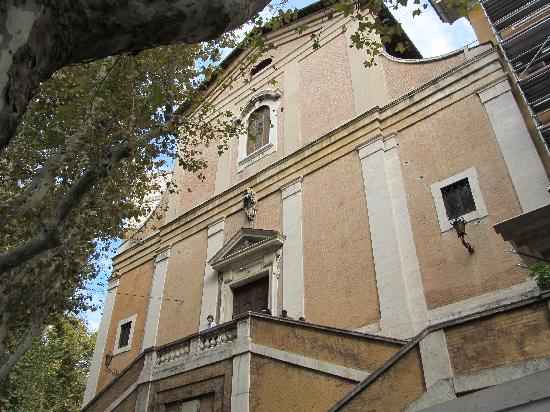
The crypt itself (which I will get to in more detail in a moment) is located beneath the church of Santa Maria della Concezione dei Cappuccini, or in English Our Lady of the Conception of the Capuchin. The little church itself was commissioned in 1626 by Pope Urban VII. Previously the Capuchin Friars had been housed elsewhere, but when they moved to this church and friary they packed up everything, including the bones of their dead and brought them here. Originally, the bones of the Friars had been buried in the Friary Via dei Lucchesi but the Pope's brother Antoni Barberini ordered everything to be moved, and in the end over 300 cart loads of bones were moved. Today, these bones can be seen arranged in the crypts beneath the friary in quite possibly some of the most morbidly fascinating crypt decorations I have ever seen.

But before you even get to see the crypts, you pay for your entrance in quite a snazzy little entrance hall in the refurbished friary. Having spoken with MadameGuillotine, not so long back you used to be greeted at the doors by one of the monks but alas, not any more (at least when we were there). You are greeted by super friendly staff members in t-shirts with the Friary's logo on. The most surprising thing when we walked in there however was how quiet the place was. Of course I didn't expect it to be anywhere near as busy as the Vatican or Colosseum. But in front of us in the queue was a small family and as we were wandering around the museum we saw no one else. In fact, the family in front of us seemed to waltz through the museum and crypts not even really giving a hoot about any of it. Whereas the two of us spent hours in there, and I have to say it was an incredibly moving experience for me.

I will mention now that whilst we were there I didn't take any photographs due to the battery on my camera running out. Where I can, I have credited any images used below.

First of all however, we get to look around the small museum which is apparently rather new. And I loved it, every single second I spent in this tiny museum totally unhindered by tourists. I have to say it was a really nice, and very peaceful change from the previous places we had been. The museum is utterly chock full of artifacts relating to the life of the Capuchin Friars. The first room we entered was full of portraits including this one by Caravaggio.

 I found this portrait mesmerising, and stood in front of it for a very long time just taking in its details. It seems that the Cappuchin's follow the example of St Francis of Assisi, but the Cappuchin's are much, much stricter than the original order. After the foundation of the order in around 1520, due to their beliefs, they were forced into hiding. But Urban VII ended up saying all was OK with it in around 1528.

The area used for the museum and crypt is used these days completely for those purposes, and just opposite the road the Friar's still live in quiet contemplation.

Beneath the museum, again of which I have no pictures other than what I have scanned in, lies the ossuary and crypt. Even though there are just 6 rooms in the crypt, we spent so much time down here gazing at the macabre decorations in front of us. I say macabre, yet at the same time it was utterly fascinating to think that the bones on show were once friars who had served at the friary. Below are some photographs (not by me) of each room, each of course with full credits to where I got them from).


The Crypt of the Resurrection.
This one is closest to the gift shop and I have to say probably one of the most moving due to the beautiful portrait. The portrait itself is framed by different bones from the human body. This crypt is said to be the least macabre of all six rooms although I have to say that even in here I had a little shudder, yet odd fascination with what I was seeing.

N.b - I'd just like the add here that all throughout my University years I had an odd fascination with human bones, hence why I'm probably flailing a lot about this...

The Mass Chapel
 This is the only room in the crypt with no bones in it. I have to say when I walked into this very peaceful room I was very surprised to not see any decoration. However it seems this room was used to pray for the souls of the dead in the surrounding crypts. There is a plaque within this room that contains the heart of the niece of Sixtus V, and it also contains the tomb of  "The Papal Zouaves" - an infantry force formed in defence of the papal states.Unfortunately I couldn't find any pictures of this room, so I'll have to ask you all to trust me when I say that this was the most peaceful room in the entire place.

The Crypt of Skulls

Looking at the picture, I wonder why it's called the Crypt of Skulls?? I have to say it was incredibly disconcerting walking into these crypts and seeing entire skeletons dressed in Capuchin Robes. I don't know if I'm the only one who felt this way?

Crypt of the Pelvys


I think the name says it all really. This one is made up mainly of pelvis bones!

Crypt of Thigh bones and Leg bones


Apparently the greatest number of bones are buried here in the whole crypt.

Crypt of the Three Skeletons


This room was probably my favourite in the entire crypt. Mainly because of the skeleton mounted on the ceiling which holds a scythe. The skellie on the ceiling is mounted within an oval and holding a scythe, a symbol of both life coming to birth (the skellie within the oval) and a symbol of death (the skellie holding the scythe). The skeleton in the centre of the ceiling is said to be the "Princess Barberini" although I have been unable to find much information on her, even from the guidebook I brought from the museum. The lady in the gift shop began to speak about her but didn't really go into much detail other than, "you need to know the story". Sadly I haven't been able to find much of her story so if anyone knows anything at all then please do drop me an email.

As I said right at the start of this post, the entire place moved me so, so much. Once we were done with the museum and crypt sadly we didn't go and see the church due to being stupidly tired and needing to recharge before finding somewhere to eat that evening. But I have to say, visiting this place was amazing and I am so, so glad that we didn't go home without visiting. Not only was the museum fantastic, but the crypts as well and full of so, so much history (including the history of later Friars who were on TV, as well as a rather moving story of a Friar who was murdered by his driver and assistant (If I could have taken pictures, again I would probably have more information but again, if anyone knows any more then please do email me).

And that was the final stop in our Rome visit. I have to say, we are looking at going again, albeit when the weather is a little bit cooler. Hopefully then we can stay a few days longer and also visit the places that we didn't get to see.

All in all though, an absolutely amazing trip that blew my mind from the moment we stepped foot in the Vatican Museum. Despite its expense (i.e. food), I would recommend visiting Rome to anyone interested in history. Because it is absolutely mind blowing.

Further Reading

The Capuchin Museum (multiple authors), 2012, The Capuchin Museum, Gangemi: Roma (only available at the Museum gift shop)


Further Information

The crypts and museum are generally open from 9am until 6.30pm (last admission), but please check the website or get in contact with the convento itself fore more information on opening.