Showing posts with label renaissance europe. Show all posts

Thursday, 17 November 2011

A Little Bit About Me

I apologise for the delay in blog posts, my laptop ended up dying on me and so had to be sent for repair. But now it's back, you lot get to put up with me posting again. Hurah! Since being computerless, I've been thinking about posts I could put up here - should it be a book review? a piece on a particular event in history? But then I realised that I've never actually really introduced myself. And now that this blog is getting a little more well known, with it's page views reaching out for 1000 and now over 50 follows on the facebook page I thought it was about time to introduce myself properly.

Me, measuring up a section of an archaeological feature

My name is Sam. Well, it's Samantha but very few people actually call me that these days. I'm 23 years old and currently live in Southampton, UK, with my partner of 4 years. It's quite a nice little life that we live here, in our little flat on the waterfront. I'm not a big fan of my day job in the clerical sector but it pays the bills and for that I'm grateful. Considering as how unemployment is on the rise and everything.

As a child I moved around a lot, as I was an army child and never settled anywhere for long. That was until we moved to rural Wiltshire. There I completed my secondary education and my love for history grew and grew. As I went through GCSE and A-Level I decided I wanted to be an archaeologist and so when the time came I went off to University in Winchester to do my degree. I started off doing a joint course in history and archaeology, but for my sins gave up history after the first year. I wish now that I hadn't, and had given up on the archaeology instead. I had some wonderful lecturers in history whilst I was there and honestly regret not staying on and taking single honours in history. But at that point, my mind was set. I graduated with an upper second class honours in archaeology in 2009 and that's when we moved to Southampton. I was one of the luckier ones in my group, and almost immediately secured a post at the Unit in Southampton whereupon I worked on digs at Tudor House and also a building site next door to a waitrose. We didn't find very much but I loved it, I didn't mind crawling out of bed at 5am on a cold, winters day and getting myself to site. I loved being knee deep in mud, I loved being on a dangerous building site, I loved working with my colleagues. But alas, it wasn't to last and as it had with many archaeologists I lost my contract. I haven't worked in archaeology since.

Instead I have allowed my love for history to take over once again and have started doing research into various historical eras that interest me greatly. My bookshelf has grown and grown within the past few years so now they're full to bursting and I have no more room; and I have decided that I will end up taking this love of history further. I have plans to go back to University and complete a Masters degree in either the history of the Renaissance or possibly early modern (think Edward VI), and one day I hope to have a few books published on my specialist areas - the research of which is being conducted pretty much as we speak. One day I also hope to teach others and to share my passion for history with those who want to learn from me. How this will begin I don't know, but I am looking at ways and means of doing this, but eventually I hope to become a lecturer.

So how did my interest in history begin? I guess I can attribute that to my Aunt who began buying me books on Ancient Egypt. I would read them from cover to cover and watch documentaries on the television and beg my parents to take me to castles. When I was much younger I remember visiting Dover Castle and falling in love with the place and I would spend hours and hours in museums too. Whilst I was at school I can remember too learning about the six wives of Henry VIII, and there being a line of printed portraits on the wall. I was drawn to two of those women: Anne Boleyn and Katherine Howard. At the time we were too young to be told the real reasons for their being beheaded - according to my primary school teacher Anne Boleyn was beheaded for being a witch (nooooo!) and Katherine Howard? Well, nothing was really ever mentioned about her. But there began my obsession with the Tudor dynasty which just grew and grew. Henry VIII has always been my favourite Tudor monarch but recently my interests have broadened, so that I have found an intense interest in the short reign of Edward VI. In fact the Tudors makes up the majority of my book collection. Other interests grew out of that, and a few years ago I developed a rather huge obsession with the English Civil War thanks to joining the reenactment society known as the Sealed Knot. In that I played the part of a musketeer, and took part in battle reenactments. I dressed in accurate portrayals of military uniform and learned every single piece of musket drill there was. From there I wanted to know more and more about the period, and the battles; and so specialised in this era during my final year at University - my dissertation was on the landscape archaeology of the Battle of Cheriton in 1644.

But honestly, anything old will always hold my interest - be it something from the Neolithic or a portrait from the Georgian era, I adore the stories that history can tell us. There is something magical about learning how these people lived, how they died, what they used in their everyday lives. And it's a passion that I hope to keep on sharing both here and in my everyday life also.

Thursday, 1 September 2011

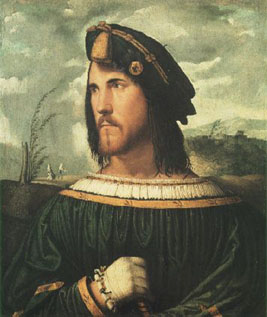
Cesare Borgia

Cesare Borgia has to be one of my favourite historical people. And why is that? Possibly because he is classified as one of the most evil men in history who killed thousands of people and the rumours that he was sleeping with his sister. But, no, not really because of that at all. I like him because he believed in himself, and he stopped at nothing to get it. There's a reason the motto on his sword is "Caesar Or Nothing", and that is because he wanted absolute power. And well, he got it! For a time at least. Below is a quick rundown of Cesare Borgia and the main events in his life.


Name: Cesare Borgia
Date of Birth: Either 14th September 1475 or sometime in 1476. The 1475 is the more likely as most sources point to this, although a few say 1476.
Titles: Cardinal of Valencia, Captain General of the Papal Armies, Gonfalonier (Standard bearer), Duke of Valentinois and Romagna.
Married to: Charlotte D'Albret.


Key facts
  • Cesare's father Rodrigo Borgia had always intended Cesare to live his life serving the church whilst Cesare's younger brother Giovanni (also known as Juan) was intended for a career in the military. However, Cesare was much more interested in military life than a life in the Roman Catholic Church.
  • He studied canon law at Perugia.
  • He was made Bishop of Pamplona at the age of 15, and a Cardinal and the Bishop of Valencia at the age of 18.
  • Cesare's brother Juan was found dead in 1497, and rumour had it that Cesare murdered him so he could get his brothers place in the papal army.
  • Upon the death of his brother, Juan the Duke of Gandia, Cesare became the first man in history to ever resign as a Cardinal.
  • In 1498 Cesare travelled to France to grant Louis XII a Papal Dispensation for his divorce from his wife Anne. For this he was rewarded with the Duchy of Valence and a marriage to the wealthy heiress Charlotte D'Albret. The two of them had a daughter named Louise although Cesare never saw her as he left his wife behind in France when he travelled back to Italy.
  • Cesare was rewarded with the command of the Papal armies when he returned and took over the Romagna which at the time was ruled over by a number of individuals. At this time Cesare ordered the drowning of the Lord of Faenza, Astorre Manfredi.
  • Leonardo Da Vinci served under Cesare as a military engineer.
  • He captured the towns of Forli, Imola, Rimini and Pesaro and installed governors which were seen as a great improvement on the previous rulers, despite how ruthless Cesare had been when taking over the towns.
  • Rodrigo Borgia, or Pope Alexander VI as he is more commonly known, died on 18th August 1503 and Cesare's military career began to dwindle. He was unable to keep the papal states together and at the time was unwell with malaria.
  • In 1504 whilst visiting Naples, Cesare was captured by Gonsalvo de Cordoba and taken to Spain where he was held prisoner at Medina Del Campo which was his first ever visit to his old diocese of Valencia.
  • He escaped in 1506, and went across the border to Navarre where he entered the servant of his brother in law John D'Albret.
  • Cesare was killed in a skirmish with the soldiers of the Constable of Navarre on 12th March 1507.
  • Cesare was originally buried in the church of Santa Maria in Viana (the town where he died) but in 1537 it was ordered that his remains be removed from the church and transferred to unconsecrated ground outside the church. In 2007 his remains were allowed to be re-interred in consecrated ground with the permission of the Bishop of Pamplona, and he was reburied in the church of Santa Maria on the day before the 500th anniversary of his death.
Of course there is much more to Cesare Borgia than a few bullet points and this man has certainly captured my imagination. Yes, Cesare was a cruel man and it's not really known how many people he actually killed, but we know he worked closely with Michelotto Corella, a man who despite being described as a deeply pious and nice man to know, was a ruthless assassin. We also know that Cesare was incredibly close to his sister Lucrezia - although there are many rumours saying that they were involved in an incestuous relationship (only made worse by the recent Assassin's Creed games! Although great games, I don't like how they played on those rumours).


I have a lot of reading and research to do not only on Cesare but on the entire Borgia family. They have to be the most infamous family of the Italian Renaissance, immersed in corruption and synonymous with some pretty horrific deeds. There are many new books on my shelf to read about this family which I am looking forward to getting stuck into, particularly the biographies of the family by Christopher Hibbert, the biography of Cesare himself by Sarah Bradford and The Prince by Machiavelli, which is said to be based on Cesare.

Sunday, 28 August 2011

A Little Bit Of Background

I have to admit, this is a little disconcerting. I'm new to this history blogging thing although I have studied history since before I can remember. I've been following a few history blogs for a while now, some alot better known than others and finally decided to start my own. But mine isn't really going to concentrate on one specific area because as a historian I have a huge interest in a lot of areas. Not only that, I'm trained an an archaeologist also and intend to share news and interesting titbits that I happen to come across. Of course, you will notice themes here too. For instance, note the title of my blog: "Caesar Or Nothing" - this is the motto of one Cesare Borgia, commander of the papal armies and general nasty piece of work. I have a huge interest in the Borgia family and the political intrigue that surrounds not only Cesare, but his father Rodrigo and his sister Lucrezia.


My main interest whilst studying archaeology at University was the battlefield archaeology of the English Civil War. This is still a huge interest of mine and my specialist battlefield is that of Cheriton in Hampshire and its surrounding area. I still read a lot on the English Civil War and research the weaponry used as well as the politics surrounding the war and the battles themselves. It is my hope that one day something more will come of my work on Cheriton. Who knows, I may even treat you all to some bits and pieces of what I discovered whilst I was conducting my research at University.


The Tudor era has always been of a huge interest to me. I can clearly remember being sat in a classroom at Primary school and learning about the Six Wives of Henry VIII, learning the rhyme that went along with them: divorced, beheaded, died, divorced, beheaded, survived. Two of the wives really spoke to me, both of whom were beheaded. The first was Katherine Howard, the young queen who had been executed for having committed adultery with other men and the second Anne Boleyn. At the time we were not told the real reasons why these two women were executed, we were far too young to understand that both had been accused of sleeping around and one of which accused of committing incest with her brother! That discovery came about much later for me. My collection of Tudor books is probably the biggest next to my collection of archaeology and English Civil War books and I particularly concentrate on the later Tudor era - think Katherine Howard and beyond, in particular the reign of little Edward VI and the Protectorship of the Duke of Somerset.


There are of course other areas that interest me - Saxon England, early medieval England, the Knights Templar, the Restoration, Renaissance Europe and the First World War.


Here I plan on sharing articles I have written, book reviews and interesting bits and pieces on the areas that I am interested in. And I hope that this site proves to be a log of my journey towards furthering my education and eventually publication.


Coming soon: a piece of work I completed just this evening on Katherine Howard - Henry VIII's Rose Without A Thorn.